
Two Fundamentally Different Processes
CNC machining and precision sheet metal fabrication both produce high-quality metal parts, but they operate on opposite principles. Machining is subtractive: a solid block or bar of material is cut away until only the desired geometry remains. Sheet metal fabrication is formative: flat stock is cut, bent, punched, and welded into shape. Understanding this distinction guides nearly every process-selection decision an engineer makes.
When CNC Machining Is the Right Choice
Complex 3D Geometry
Machining excels at three-dimensional features that cannot be formed from flat stock — deep pockets, contoured surfaces, precision bores, and internal threads. If your design requires tight tolerances on cylindrical features, mating faces, or compound angles, a machined part almost always delivers more consistent results than a fabricated one.
High-Strength Monolithic Structures
Parts that must sustain significant mechanical loads without weld joints benefit from being machined from a single billet. Structural brackets, manifolds, hydraulic bodies, and housings for rotating machinery are natural candidates. Weld joints introduce heat-affected zones and residual stress; a machined component avoids both.
Tight Dimensional Control
Where tolerances are measured in thousandths of an inch across multiple interacting features, CNC milling and turning provide the repeatability and measurement accessibility that sheet metal processes cannot match. Precision bores for bearing seats, controlled thread depths, and exact parting-surface flatness are machining's home territory.
When Precision Sheet Metal Is the Right Choice
Enclosures, Panels, and Housings
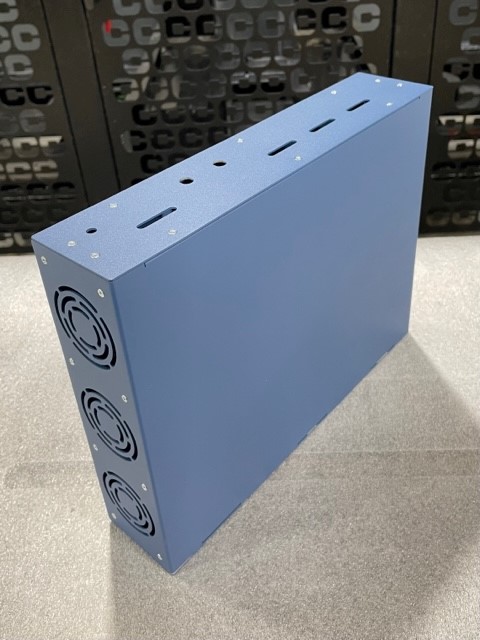
Sheet metal is the dominant process for enclosures, chassis, rack panels, and covers. Forming flat material into box shapes is highly efficient — material use is optimized, and features like tabs, slots, flanges, and embosses are inexpensive to add at the laser or press brake stage. A welded and finished sheet metal enclosure almost always costs less than a machined equivalent.
Large, Thin-Walled Parts
Machining a large, thin-walled structure from solid stock wastes material and creates deflection challenges during cutting. Sheet metal handles this geometry naturally. If your part is primarily a structural skin rather than a load-bearing block, formed sheet is almost certainly the better process.
Weight and Material Efficiency
Because sheet metal removes no material — it only shapes it — there is virtually no waste beyond the cut-out blank. For programs with material cost sensitivity or weight budgets, this efficiency advantage compounds across production volumes.
Hybrid Designs: Getting the Best of Both
Many real-world assemblies benefit from combining both processes. An electronic enclosure might use precision sheet metal for the main chassis and doors while relying on machined aluminum extrusions for mounting rails and machined panels for connector cutouts that require tight positional tolerances. Designing with process boundaries in mind — rather than forcing a single process to do everything — typically yields the best combination of cost, weight, and performance.
Cost Drivers to Understand
Machining cost is primarily driven by material removal rate, fixturing complexity, number of setups, and tolerance requirements. Sheet metal cost is driven by blank size, number of bends, weld length, and finish complexity. Neither process is universally cheaper — the part geometry determines which is appropriate, and the appropriate process is almost always the less expensive one when matched correctly to the design.
Getting Expert Input Early
Process selection is most effective when raised during design, not after drawings are released. Mikron Manufacturing offers both CNC machining and precision sheet metal fabrication under one roof, which means their team can evaluate a design holistically and recommend the process — or combination — that best serves your program. Reach out through the CNC machining or precision sheet metal pages to start a conversation.
Ready to Put This Into Practice?
Upload your drawings or send Mikron a request for quote — the team will review your project and respond promptly.