
Why Material Selection Is a Manufacturing Decision, Not Just a Design Decision
Engineers often select materials based on mechanical properties — strength, stiffness, density, corrosion resistance — without fully accounting for how those materials behave under cutting tools. Two materials with similar static strength can have dramatically different machinability ratings, translating directly into cycle time, tool life, and ultimately cost. Integrating machinability into the material selection process produces better outcomes on both the engineering and the business side.
Aluminum Alloys
Aluminum is the most commonly machined material in precision contract manufacturing, and for good reason. Most aluminum alloys machine quickly and cleanly, producing excellent surface finishes at high material removal rates. The 6061-T6 alloy is the workhorse of the industry — strong enough for most structural applications, widely available, and highly machinable. 7075-T6 offers significantly higher strength at a modest increase in cost and slight reduction in machinability. 2024 and MIC-6 tooling plate are common choices for tight-tolerance applications requiring dimensional stability.
Aluminum accepts anodizing, chemical film (Alodine), and powder coat finishes readily. Anodizing both improves corrosion resistance and can be dyed for identification or cosmetic purposes. Confirm finish compatibility when selecting an aluminum alloy for a specific application.
Stainless Steel
Stainless steels offer excellent corrosion resistance and high strength, but they are significantly more difficult to machine than aluminum. Work hardening during cutting is a particular challenge — a tool that dwells in a cut or runs too slowly can harden the surface ahead of the cut, accelerating tool wear. Chip control is also more demanding than with aluminum. The result is slower cycle times and higher tooling costs compared to aluminum parts of equivalent complexity.
304 and 316 stainless are the most common free-machining grades. 17-4 PH stainless, often used in aerospace and defense applications for its combination of high strength and moderate corrosion resistance, is considerably more challenging to machine and commands a correspondingly higher machining cost.
Brass and Copper Alloys
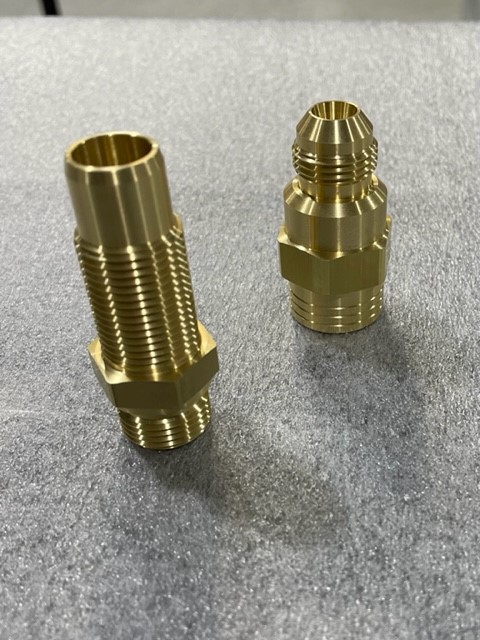
Free-machining brass (C360) is among the easiest materials to machine, cutting cleanly at high speeds with excellent surface finish and long tool life. It is the standard material for turned fittings, connectors, and precision threaded components. Copper alloys are chosen where electrical conductivity is the primary requirement. Both materials are more expensive per pound than aluminum or mild steel but often cost less per finished part due to their excellent machinability.
Mild and Alloy Steels
Mild steel (1018, A36) machines well and is inexpensive, making it appropriate for structural and non-critical components. Alloy steels like 4140 and 4340 offer higher strength and hardness but machine more slowly. Heat-treated alloy steels — particularly those hardened above 40 HRC — require special tooling and processes and are substantially more expensive to machine than annealed stock. If a steel part requires post-machining heat treatment, discuss dimensional changes with your manufacturer before finalizing tolerances.
Engineering Plastics
Delrin (acetal), UHMW polyethylene, nylon, and PEEK are commonly machined when low weight, electrical insulation, or chemical resistance is required. Plastics machine quickly but present unique challenges: thermal expansion during cutting, stress relief after machining, and the difficulty of holding tight tolerances on large features. Moisture absorption in nylon can affect dimensional stability in humid environments. Confirm your dimensional requirements against the material's thermal and moisture properties before finalizing the design.
Matching Material to Application — A Practical Summary
Choose the least-difficult-to-machine material that satisfies your functional requirements. Specify material by alloy designation and temper, not generic family. Consider finish compatibility at the material selection stage. And when in doubt, bring your application requirements to your manufacturer — an experienced team can suggest alloys that meet your needs while remaining cost-effective to process. Mikron's team works with a wide range of materials and can provide application-specific guidance; contact them through the CNC machining page.
Ready to Put This Into Practice?
Upload your drawings or send Mikron a request for quote — the team will review your project and respond promptly.